
This site was created on the behalf of the unemployed, and for those, who currently are neither working, nor looking for work, but have indicated, they want and are available for a job and have looked for work sometime in the past 12 months. It’s also, for those persons employed part time for economic reasons, who want, and are available for full-time work in President Donald Trump’s economy, but have had to settle for a part-time schedule, across this great nation. This site advocates for the underemployed, and those who are struggling, each and every day, to live some semblance of the lifestyle, they had prior to these Economic Downturns.
The Question We Should Be Asking, as Voters is, “What happens once Democrats are in OFFICE and Take Power?! Our community is BLESSED, when Americans Have Jobs.”
The #1 issues of Americans are “Jobs, the Economy, and Inflation (Affordability).” A 5 or 10 year (the Democratic party’s choosing), 10% $25,000 Consumer Tax Cut for the bottom 70-80% will resolve all 3 issues – Jobs, the Economy and Inflation. We as voters should demand, the first legislative act of the Democratic party should be to put on the House floor, a 10% $25,000 Consumer Tax Cut. We can do this by letting Democratic Minority party leadership know “specifically” what our desires are.
Text them, call them, email them, and comment on the Facebook pages of Minority Leader (soon to be the Majority Leader) in the House of Representatives Hakeem Jeffries, Minority Leader (soon to be Majority Leader) in the Senate Chuck Schumer, current Congressional Black Caucus Leader, Yvette Clark and others. Tell them, as stated above, a 5 or 10 year 10% $25,000 Consumer Tax Cut to the bottom 70-80%, which will create Jobs, grow our Economy, and address Inflation, is needed and is the SOLUTION to the nation’s economic woes.
Put your support behind this Consumer Tax Cut, KNOCK ON THE DOORS of policymakers, and help push through this federal legislation, as Dr. King and his band of brothers and sisters did, with historical legislation in the 1960s. We implore you, to help us convince Congress of the value of a 10% $25,000 Consumer Tax Cut to the bottom 70-80% with Baby Boomers being the first recipients.
The Republicans have wrongly used, and taken advantage of Voters, and working-class Americans, when it comes to tax cuts. They have proposed and pushed through Congress 5(five) major tax cuts, since 1986, with all of them primarily benefitting the top 10-20% consumer group. Trump’s One Big Beautiful Bill, a $3.4 trillion behemoth, being the largest in history, promised a “Blue Collar Boom,” that has yet to occur, as the economy lost 133,000 Jobs in February, and created only 29,000 Jobs in September, as shown, by our most recent monthly report of Job creation, which is woefully inadequate.
Congress, if prompted by voters, can extend the tax cut to the next generation of retirees, based on the formula as established by this original Boomer Consumer Tax Cut. Thus, this “Direct” Consumer Tax Cut, is an opportunity for one generation, the Baby Boomers (1946-1964), to leave a beneficially positive economic legacy of “reformation to America’s capitalist system,” that will benefit and be felt financially, by future generations, and indeed the world, demonstrating Capitalism can consistently work for all of us, when it comes to “long-term JOB CREATION and generational wealth:” Generation X (1965-1980); Millennials (1981-1996); and even Generation Z (1997-2012).
The Federal Reserve has published its intention to raise interest rates in the coming years, starting December 2026, 2027, and maybe to 2028, if necessary to bring inflation under control. Higher rates, will slow the economy, creating layoffs. Traditionally, Black Americans are the first laid-off as the Economy turns downward. Even if, it will be a slow regimented type of process of rate increases, a slow churn if you will, it will be, nevertheless, Black American workers who will be set-back the most, economically.
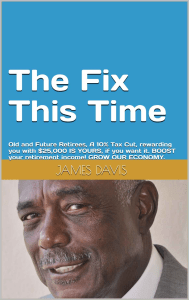
My name is James Davis, I’m a Financial Analyst, a graduate of Florida A. and M. University (FAMU); was awarded the Florida’s Governor Burns Scholarship to attend FAMU, and while at FAMU was awarded its first Martin Luther King Scholarship. I am the author of a book, titled “The Fix This Time.” It is a book about how to boost retirement Income and Simultaneously Create Jobs and Spur Economic Growth (https://www.amazon.com/dp/B00MI3PD2M). I also have written a series of articles, as one of the featured writers about the current political and economic experiences of American workers, at ThyBlackman.com. As with most black writers, who express the truth, as they know it factually, my well researched and published works have not received the media attention my white counter parts have gotten.
Having said this – following is a link to one of the most relevant of those articles, featuring Senator E. Warren, where she explains in a video clip, just how Federal Reserve interest rate cycle increases, work. You should click on the linked article and watch the video within the article. It was of course, when Jerome Powell was the Fed Chairman, but it gives you an understanding of how these rate increase cycles work. The second linked article which is not a part of the Thy Blackman collection is from this web site, “The Fix This Time” (TheFixThisTime.com).
It details a “Doable 10% Consumer Tax Cut Plan,” that, if legislated, will literally eliminate the negative impact of layoffs, as the Federal Reserve raises interest rates under its current Chairman Kevin Warsh.
It would be my pleasure to do a formal, in person presentation, when it comes to this current chapter of economic upheaval, we are experiencing. Such a presentation will give you, your organizational members and the audience, an opportunity to ask questions about my articles, and how “the Doable 10% Consumer Tax Cut,” can become a reality, minimizing the disastrous consequences of these coming layoffs and demonstrating 3-5% U.S. economic growth is doable. Here are the linked articles.
As an advocate, convicted, and convinced of “the positive results,” which can be realized, if this long-term Deficit Neutral Job Creation and Economic Growth Plan and Proposal is actualized, I want you, (yes, you), and every single person coming to this site to become an advocate. Did I say, “the proposal is Deficit Neutral,” meaning it will produce “surplus revenues,” which will result in “new taxable revenues streams for city, state, and federal governments to spend.“
In the course of human events, such as these horrific Economic Downturns, “we the people” have an obligation to step forth, when our political representatives fail us, and demand our government, which was created by us, fulfill its obligation to us, of promoting our general welfare. We should do this willingly, with “good will in our hearts,” being fierce advocators “of ourselves,” and our countrymen, countrywomen, of our sons, and daughters who are hurting economically due to no fault of their own.
We did not cause these Economic Downturns; We are victims of them. Please JOIN, purchase the book for the reduced price of $9.99, and together Create Jobs and Grow the U.S. Economy.
FREE market Capitalism works every time!


Dear Mr. Davis. You write that “it was decided by Clinton and Reich that the U-3 category would become his administration’s official unemployment rate.” That is untrue. The Bureau of Labor Statistics is a statistical agency whose independence from politics is critically important to its credibility. Neither I as secretary of labor nor President Clinton intruded on that independence. The BLS decided and continues to decide how the nation’s unemployment rate is defined, measured, and explained to the public.
LikeLiked by 1 person
I don’t understand how that is possible as the Bureau of Labor Statistics is a division or section within the Labor Department. How could they make such a decision or draw such a conclusion as major as that without input, and guidance from the Secretary of Labor. I get that the BLS collects and presents data regarding labor statistics, as a function of their bureau, but deciding what category of unemployment rates will be used without the Secretary of Labor input isn’t logical. A bureau just doesn’t have that power.
LikeLike
https://www.tallahassee.com/story/news/local/2026/05/22/folks-gather-at-goodwood-to-honor-70th-anniversary-of-bus-boycott/90206687007/?utm_source=ptal-DailyBriefing&utm_medium=email&utm_campaign=daily-briefing&utm_term=Content%20List%20-%20Stacking%20-%20optimized&utm_content=1558TD-E-NLETTER65
LikeLike
Media coverage of the Tallahassee Bus Boycott.
LikeLike